

What Is The Ideal Group Size For A Problem-solving Discussion?
14.3 Problem Solving and Determination Making in Groups
Learning Objectives
- Discuss the common components and characteristics of problems.
- Explain the v steps of the group problem-solving process.
- Describe the brainstorming and discussion that should have place before the grouping makes a decision.
- Compare and dissimilarity the dissimilar controlling techniques.
- Hash out the various influences on decision making.
Although the steps of problem solving and decision making that we will discuss next may seem obvious, we oftentimes don't think to or choose non to use them. Instead, we beginning working on a problem and later realize nosotros are lost and have to backtrack. I'grand sure we've all reached a point in a projection or task and had the "OK, now what?" moment. I've recently taken upward some carpentry projects as a functional hobby, and I take developed a great respect for the importance of advanced planning. It's frustrating to get to a crucial point in edifice or fixing something merely to realize that you have to unscrew a support board that you lot already screwed in, have to drive back to the hardware shop to get something that yous didn't think to get earlier, or have to completely start over. In this section, we will discuss the grouping problem-solving process, methods of decision making, and influences on these processes.
Group Problem Solving
The trouble-solving procedure involves thoughts, discussions, actions, and decisions that occur from the starting time consideration of a problematic situation to the goal. The bug that groups face are varied, but some common problems include budgeting funds, raising funds, planning events, addressing customer or citizen complaints, creating or adapting products or services to fit needs, supporting members, and raising awareness virtually problems or causes.
Bug of all sorts accept three common components (Adams & Galanes, 2009):
- An undesirable situation. When conditions are desirable, in that location isn't a problem.
- A desired situation. Even though it may only be a vague thought, at that place is a drive to amend the undesirable situation. The vague idea may develop into a more precise goal that can be accomplished, although solutions are non yet generated.
- Obstacles between undesirable and desirable situation. These are things that stand in the way between the current situation and the group's goal of addressing it. This component of a trouble requires the virtually piece of work, and information technology is the role where determination making occurs. Some examples of obstacles include express funding, resource, personnel, fourth dimension, or data. Obstacles can also take the class of people who are working against the group, including people resistant to alter or people who disagree.
Word of these three elements of a problem helps the grouping tailor its problem-solving process, as each problem will vary. While these three general elements are present in each problem, the grouping should also address specific characteristics of the problem. Five common and of import characteristics to consider are task difficulty, number of possible solutions, group fellow member interest in problem, group member familiarity with problem, and the demand for solution credence (Adams & Galanes, 2009).
- Task difficulty. Hard tasks are besides typically more complex. Groups should be prepared to spend time researching and discussing a difficult and complex task in order to develop a shared foundational knowledge. This typically requires individual work outside of the group and frequent group meetings to share information.
- Number of possible solutions. There are ordinarily multiple ways to solve a problem or complete a job, but some problems have more potential solutions than others. Figuring out how to ready a embankment house for an budgeted hurricane is fairly complex and difficult, but there are still a limited number of things to exercise—for example, taping and boarding up windows; turning off water, electricity, and gas; trimming copse; and securing loose outside objects. Other problems may be more creatively based. For example, designing a new restaurant may entail using some standard solutions but could too entail many dissimilar types of innovation with layout and pattern.
- Group member interest in trouble. When grouping members are interested in the problem, they volition exist more engaged with the problem-solving procedure and invested in finding a quality solution. Groups with loftier interest in and noesis virtually the problem may desire more freedom to develop and implement solutions, while groups with low interest may prefer a leader who provides structure and management.
- Group familiarity with problem. Some groups encounter a problem regularly, while other problems are more unique or unexpected. A family who has lived in hurricane alley for decades probably has a better idea of how to fix its house for a hurricane than does a family that simply recently moved from the Midwest. Many groups that rely on funding accept to revisit a upkeep every year, and in contempo years, groups have had to get more than creative with budgets as funding has been cutting in nigh every sector. When grouping members aren't familiar with a trouble, they volition demand to practice background research on what similar groups have done and may as well need to bring in outside experts.
- Need for solution acceptance. In this stride, groups must consider how many people the conclusion will bear upon and how much "buy-in" from others the grouping needs in order for their solution to be successfully implemented. Some pocket-size groups have many stakeholders on whom the success of a solution depends. Other groups are answerable only to themselves. When a small grouping is planning on building a new park in a crowded neighborhood or implementing a new policy in a big concern, it can be very difficult to develop solutions that will be accepted by all. In such cases, groups will desire to poll those who will be affected by the solution and may desire to do a pilot implementation to come across how people react. Imposing an first-class solution that doesn't have buy-in from stakeholders can still lead to failure.
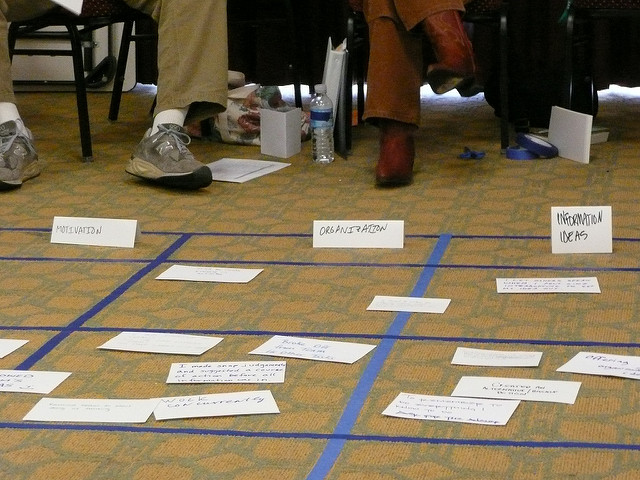
Group problem solving tin can be a disruptive puzzle unless information technology is approached systematically.
Group Problem-Solving Process
At that place are several variations of similar problem-solving models based on US American scholar John Dewey's reflective thinking process (Bormann & Bormann, 1988). Every bit you read through the steps in the process, think about how you can use what we learned regarding the general and specific elements of issues. Some of the following steps are straightforward, and they are things we would logically do when faced with a trouble. However, taking a deliberate and systematic approach to problem solving has been shown to benefit group performance and performance. A deliberate approach is especially beneficial for groups that do non have an established history of working together and will just be able to meet occasionally. Although a group should attend to each pace of the process, group leaders or other group members who facilitate problem solving should be cautious not to dogmatically follow each chemical element of the procedure or force a grouping forth. Such a lack of flexibility could limit group fellow member input and negatively bear on the group's cohesion and climate.
Step 1: Define the Trouble
Define the trouble by considering the three elements shared by every trouble: the current undesirable state of affairs, the goal or more desirable situation, and obstacles in the way (Adams & Galanes, 2009). At this phase, group members share what they know almost the current state of affairs, without proposing solutions or evaluating the information. Hither are some good questions to ask during this stage: What is the current difficulty? How did we come to know that the difficulty exists? Who/what is involved? Why is it meaningful/urgent/of import? What take the furnishings been so far? What, if any, elements of the difficulty crave clarification? At the terminate of this phase, the group should exist able to compose a single sentence that summarizes the trouble called a problem argument. Avoid wording in the problem statement or question that hints at potential solutions. A minor group formed to investigate ethical violations of metropolis officials could employ the following trouble statement: "Our state does not currently have a mechanism for citizens to written report suspected ethical violations by city officials."
Stride two: Analyze the Problem
During this step a grouping should analyze the problem and the group'southward relationship to the problem. Whereas the first footstep involved exploring the "what" related to the problem, this step focuses on the "why." At this stage, group members can discuss the potential causes of the difficulty. Grouping members may also want to begin setting out an agenda or timeline for the group'south trouble-solving procedure, looking forward to the other steps. To fully analyze the problem, the group tin discuss the v common problem variables discussed before. Here are ii examples of questions that the group formed to address ethics violations might ask: Why doesn't our city have an ethics reporting machinery? Practise cities of similar size take such a mechanism? Once the problem has been analyzed, the group tin can pose a problem question that will guide the group as it generates possible solutions. "How can citizens written report suspected ethical violations of city officials and how will such reports exist candy and addressed?" Every bit y'all can see, the problem question is more complex than the trouble statement, since the group has moved on to more in-depth discussion of the problem during step 2.
Step 3: Generate Possible Solutions
During this step, group members generate possible solutions to the problem. Again, solutions should not be evaluated at this point, only proposed and clarified. The question should be what could we practice to address this trouble, not what should we practise to address it. It is perfectly OK for a grouping member to question another person's idea by asking something like "What do you lot mean?" or "Could you explain your reasoning more than?" Discussions at this stage may reveal a need to return to previous steps to improve define or more fully clarify a problem. Since many problems are multifaceted, it is necessary for group members to generate solutions for each function of the trouble separately, making sure to take multiple solutions for each part. Stopping the solution-generating process prematurely tin can lead to groupthink. For the trouble question previously posed, the group would need to generate solutions for all iii parts of the problem included in the question. Possible solutions for the first function of the trouble (How can citizens report upstanding violations?) may include "online reporting arrangement, e-mail, in-person, anonymously, on-the-record," and so on. Possible solutions for the second part of the problem (How will reports exist processed?) may include "daily past a newly appointed ethics officer, weekly past a nonpartisan nongovernment employee," and and then on. Possible solutions for the third part of the problem (How will reports be addressed?) may include "by a newly appointed ideals commission, past the accused's supervisor, by the city managing director," and so on.
Step four: Evaluate Solutions
During this step, solutions can be critically evaluated based on their credibility, abyss, and worth. Once the potential solutions accept been narrowed based on more than obvious differences in relevance and/or merit, the grouping should analyze each solution based on its potential effects—peculiarly negative effects. Groups that are required to study the rationale for their decision or whose decisions may be subject to public scrutiny would be wise to brand a fix listing of criteria for evaluating each solution. Additionally, solutions can exist evaluated based on how well they fit with the grouping's charge and the abilities of the grouping. To do this, grouping members may ask, "Does this solution alive upwards to the original purpose or mission of the group?" and "Can the solution actually be implemented with our current resource and connections?" and "How will this solution be supported, funded, enforced, and assessed?" Secondary tensions and substantive conflict, 2 concepts discussed before, sally during this step of problem solving, and group members will need to employ effective disquisitional thinking and listening skills.
Determination making is role of the larger process of problem solving and it plays a prominent role in this step. While there are several fairly similar models for problem solving, in that location are many varied decision-making techniques that groups can use. For example, to narrow the listing of proposed solutions, group members may determine by majority vote, past weighing the pros and cons, or by discussing them until a consensus is reached. There are too more complex decision-making models like the "vi hats method," which we volition discuss subsequently. Once the terminal decision is reached, the grouping leader or facilitator should confirm that the grouping is in agreement. It may be beneficial to let the group pause for a while or even to delay the final determination until a later coming together to let people time to evaluate it outside of the group context.
Stride 5: Implement and Appraise the Solution
Implementing the solution requires some advanced planning, and it should not be rushed unless the grouping is operating under strict time restraints or delay may atomic number 82 to some kind of harm. Although some solutions can be implemented immediately, others may take days, months, or years. As was noted earlier, it may be beneficial for groups to poll those who will exist affected by the solution as to their stance of information technology or even to practice a pilot test to notice the effectiveness of the solution and how people react to it. Before implementation, groups should likewise determine how and when they would assess the effectiveness of the solution by asking, "How will we know if the solution is working or non?" Since solution cess will vary based on whether or not the group is disbanded, groups should also consider the following questions: If the group disbands after implementation, who volition be responsible for assessing the solution? If the solution fails, will the aforementioned group reconvene or volition a new group exist formed?

Once a solution has been reached and the grouping has the "green lite" to implement it, information technology should proceed deliberately and cautiously, making sure to consider possible consequences and address them as needed.
Certain elements of the solution may need to be delegated out to various people inside and outside the grouping. Group members may also exist assigned to implement a particular office of the solution based on their function in the decision making or considering it connects to their expanse of expertise. As well, group members may be tasked with publicizing the solution or "selling" it to a particular group of stakeholders. Concluding, the group should consider its hereafter. In some cases, the group will become to decide if it will stay together and continue working on other tasks or if it volition disband. In other cases, outside forces determine the group's fate.
"Getting Competent"
Problem Solving and Group Presentations
Giving a group presentation requires that individual grouping members and the group every bit a whole solve many issues and make many decisions. Although having more than people involved in a presentation increases logistical difficulties and has the potential to create more conflict, a well-prepared and well-delivered grouping presentation tin be more engaging and effective than a typical presentation. The main problems facing a grouping giving a presentation are (ane) dividing responsibilities, (2) coordinating schedules and fourth dimension management, and (iii) working out the logistics of the presentation delivery.
In terms of dividing responsibilities, assigning individual work at the first coming together and and so trying to fit it all together before the presentation (which is what many college students exercise when faced with a grouping project) is not the recommended method. Integrating content and visual aids created past several different people into a seamless last product takes time and endeavor, and the person "stuck" with this chore at the end commonly ends upwards developing some resentment toward his or her group members. While information technology'southward OK for group members to do piece of work independently outside of grouping meetings, spend time working together to help prepare some standards for content and formatting expectations that will help make later integration of work easier. Taking the fourth dimension to consummate one part of the presentation together can help set those standards for subsequently individual work. Discuss the roles that various group members will play openly and so there isn't role confusion. There could be one signal person for keeping track of the group'southward progress and schedule, i point person for communication, one point person for content integration, i point person for visual aids, and and then on. Each person shouldn't exercise all that piece of work on his or her ain but help focus the group'south attention on his or her specific area during grouping meetings (Stanton, 2009).
Scheduling group meetings is one of the most challenging problems groups confront, given people's busy lives. From the beginning, information technology should be clearly communicated that the group needs to spend considerable time in face-to-face meetings, and group members should know that they may have to make an occasional cede to attend. Especially important is the commitment to scheduling fourth dimension to rehearse the presentation. Consider creating a contract of group guidelines that includes expectations for meeting attendance to increase grouping members' commitment.
Group presentations crave members to navigate many logistics of their presentation. While it may be easier for a group to assign each member to create a 5-infinitesimal segment and and so transition from one person to the next, this is definitely not the most engaging method. Creating a chief presentation and then assigning private speakers creates a more fluid and dynamic presentation and allows everyone to go familiar with the content, which can help if a person doesn't evidence upwards to present and during the question-and-answer department. Once the content of the presentation is consummate, figure out introductions, transitions, visual aids, and the use of time and space (Stanton, 2012). In terms of introductions, effigy out if ane person will innovate all the speakers at the starting time, if speakers will introduce themselves at the beginning, or if introductions will occur as the presentation progresses. In terms of transitions, make certain each person has included in his or her speaking notes when presentation duties switch from 1 person to the next. Visual aids have the potential to cause hiccups in a group presentation if they aren't fluidly integrated. Practicing with visual aids and having i person command them may help prevent this. Know how long your presentation is and know how you're going to utilize the space. Presenters should know how long the whole presentation should be and how long each of their segments should be so that everyone tin can share the responsibility of keeping time. Too consider the size and layout of the presentation infinite. You don't desire presenters huddled in a corner until it's their turn to speak or trapped backside furniture when their turn comes around.
- Of the three main problems facing group presenters, which do yous recall is the nigh challenging and why?
- Why do you think people tasked with a group presentation (especially students) prefer to divide the parts up and take members work on them independently before coming back together and integrating each part? What problems emerge from this method? In what means might developing a principal presentation and and so assigning parts to dissimilar speakers exist better than the more divided method? What are the drawbacks to the principal presentation method?
Decision Making in Groups
Nosotros all engage in personal decision making daily, and we all know that some decisions are more than hard than others. When we make decisions in groups, we face some challenges that nosotros practice not face in our personal decision making, but we too stand to benefit from some advantages of group determination making (Napier & Gershenfeld, 2004). Grouping decision making tin appear fair and autonomous just actually only be a gesture that covers up the fact that sure grouping members or the group leader have already decided. Group decision making also takes more than time than individual decisions and tin can be crushing if some group members do not practice their assigned work, divert the group with self-centered or unproductive role behaviors, or miss meetings. Conversely, though, group decisions are ofttimes more informed, since all group members develop a shared understanding of a problem through give-and-take and argue. The shared understanding may also be more complex and deep than what an individual would develop, because the group members are exposed to a variety of viewpoints that can broaden their own perspectives. Group decisions also benefit from synergy, one of the key advantages of group advice that we discussed before. About groups practice not use a specific method of determination making, possibly thinking that they'll work things out as they go. This can pb to diff participation, social loafing, premature decisions, prolonged discussion, and a host of other negative consequences. And then in this department we will learn some practices that will prepare us for good conclusion making and some specific techniques we can utilise to help us reach a final decision.
Brainstorming earlier Determination Making
Before groups can make a determination, they need to generate possible solutions to their problem. The most commonly used method is brainstorming, although most people don't follow the recommended steps of brainstorming. As you'll recall, brainstorming refers to the quick generation of ideas gratis of evaluation. The originator of the term brainstorming said the following iv rules must be followed for the technique to be effective (Osborn, 1959):
- Evaluation of ideas is forbidden.
- Wild and crazy ideas are encouraged.
- Quantity of ideas, not quality, is the goal.
- New combinations of ideas presented are encouraged.
To make brainstorming more of a decision-making method rather than an idea-generating method, group communication scholars have suggested boosted steps that precede and follow brainstorming (Cragan & Wright, 1991).
- Do a warm-up brainstorming session. Some people are more apprehensive about publicly communicating their ideas than others are, and a warm-up session can help ease apprehension and prime group members for task-related idea generation. The warm-upwardly can exist initiated by anyone in the grouping and should but keep for a few minutes. To get things started, a person could ask, "If our group formed a band, what would we be called?" or "What other purposes could a mailbox serve?" In the previous examples, the starting time warm up gets the group's more abstruse creative juices flowing, while the second focuses more than on applied and concrete ideas.
- Practice the bodily brainstorming session. This session shouldn't final more than thirty minutes and should follow the four rules of brainstorming mentioned previously. To ensure that the 4th dominion is realized, the facilitator could encourage people to piggyback off each other'due south ideas.
- Eliminate duplicate ideas. Later on the brainstorming session is over, group members can eliminate (without evaluating) ideas that are the aforementioned or very similar.
- Clarify, organize, and evaluate ideas. Before evaluation, encounter if any ideas demand clarification. Then endeavor to theme or group ideas together in some orderly fashion. Since "wild and crazy" ideas are encouraged, some suggestions may need clarification. If it becomes clear that in that location isn't really a foundation to an idea and that information technology is likewise vague or abstract and tin can't be clarified, it may be eliminated. As a circumspection though, it may be wise to non throw out off-the-wall ideas that are hard to categorize and to instead put them in a miscellaneous or "wild and crazy" category.
Give-and-take before Decision Making
The nominal grouping technique guides determination making through a four-step process that includes idea generation and evaluation and seeks to elicit equal contributions from all group members (Delbecq & Ven de Ven, 1971). This method is useful because the procedure involves all grouping members systematically, which fixes the trouble of uneven participation during discussions. Since everyone contributes to the discussion, this method tin can besides help reduce instances of social loafing. To use the nominal group technique, practice the following:
- Silently and individually list ideas.
- Create a main list of ideas.
- Analyze ideas as needed.
- Have a cloak-and-dagger vote to rank grouping members' credence of ideas.
During the first step, have grouping members work quietly, in the same infinite, to write down every idea they have to address the chore or problem they face up. This shouldn't take more than than twenty minutes. Whoever is facilitating the discussion should remind group members to use brainstorming techniques, which means they shouldn't evaluate ideas equally they are generated. Ask group members to remain silent once they've finished their listing so they practise not distract others.
During the second pace, the facilitator goes effectually the group in a consistent order asking each person to share 1 idea at a time. As the idea is shared, the facilitator records information technology on a master listing that everyone can run across. Keep rail of how many times each idea comes upwards, as that could be an idea that warrants more discussion. Keep this process until all the ideas have been shared. As a note to facilitators, some group members may begin to edit their list or cocky-censor when asked to provide i of their ideas. To limit a person'south apprehension with sharing his or her ideas and to ensure that each idea is shared, I take asked grouping members to exchange lists with someone else and so they tin can share ideas from the list they receive without fright of being personally judged.
During stride iii, the facilitator should note that group members tin now ask for clarification on ideas on the master list. Exercise not let this discussion stray into evaluation of ideas. To assistance avoid an unnecessarily long discussion, it may be useful to go from one person to the side by side to ask which ideas need clarifying so go to the originator(s) of the thought in question for description.
During the fourth pace, members use a voting election to rank the acceptability of the ideas on the master list. If the list is long, y'all may enquire group members to rank but their top five or so choices. The facilitator then takes upwards the secret ballots and reviews them in a random social club, noting the rankings of each idea. Ideally, the highest ranked thought tin can so be discussed and decided on. The nominal group technique does not carry a group all the manner through to the point of determination; rather, it sets the grouping upward for a roundtable discussion or use of some other method to evaluate the claim of the superlative ideas.
Specific Decision-Making Techniques
Some conclusion-making techniques involve determining a course of activeness based on the level of agreement among the group members. These methods include majority, adept, authority, and consensus rule. Table fourteen.1 "Pros and Cons of Understanding-Based Controlling Techniques" reviews the pros and cons of each of these methods.

Majority rule is a unproblematic method of decision making based on voting. In most cases a majority is considered half plus one.
Becky McCray – Voting – CC BY-NC-ND 2.0.
Majority rule is a commonly used conclusion-making technique in which a majority (one-one-half plus one) must agree earlier a decision is made. A show-of-hands vote, a paper ballot, or an electronic voting system can determine the majority selection. Many decision-making bodies, including the United states of america House of Representatives, Senate, and Supreme Court, use bulk rule to make decisions, which shows that it is often associated with democratic determination making, since each person gets ane vote and each vote counts every bit. Of class, other individuals and mediated messages can influence a person's vote, but since the voting power is spread out over all group members, it is not easy for one person or party to take control of the conclusion-making process. In some cases—for example, to override a presidential veto or to ameliorate the constitution—a super bulk of two-thirds may be required to brand a decision.
Minority rule is a controlling technique in which a designated dominance or expert has final say over a decision and may or may not consider the input of other group members. When a designated expert makes a decision by minority dominion, in that location may be purchase-in from others in the group, specially if the members of the group didn't take relevant noesis or expertise. When a designated authority makes decisions, buy-in will vary based on group members' level of respect for the potency. For case, decisions made past an elected authority may exist more accepted by those who elected him or her than past those who didn't. As with bulk rule, this technique can be fourth dimension saving. Unlike majority dominion, 1 person or party tin can have control over the decision-making process. This type of decision making is more like to that used by monarchs and dictators. An obvious negative consequence of this method is that the needs or wants of one person can override the needs and wants of the majority. A minority deciding for the majority has led to negative consequences throughout history. The white Afrikaner minority that ruled South Africa for decades instituted apartheid, which was a system of racial segregation that disenfranchised and oppressed the majority population. The quality of the decision and its fairness really depends on the designated expert or authority.
Consensus rule is a decision-making technique in which all members of the grouping must agree on the same decision. On rare occasions, a decision may be ideal for all grouping members, which can lead to unanimous agreement without farther debate and discussion. Although this can be positive, be cautious that this isn't a sign of groupthink. More than typically, consensus is reached only after lengthy discussion. On the plus side, consensus oftentimes leads to high-quality decisions due to the time and effort it takes to get everyone in agreement. Group members are also more than likely to be committed to the determination because of their investment in reaching it. On the negative side, the ultimate decision is often one that all group members can live with but not one that's ideal for all members. Additionally, the process of arriving at consensus also includes conflict, as people fence ideas and negotiate the interpersonal tensions that may effect.
Table 14.one Pros and Cons of Agreement-Based Decision-Making Techniques
| Conclusion-Making Technique | Pros | Cons |
|---|---|---|
| Majority rule |
|
|
| Minority rule past skillful |
|
|
| Minority dominion past authorization |
|
|
| Consensus rule |
|
|
"Getting Disquisitional"
Six Hats Method of Decision Making
Edward de Bono adult the Half-dozen Hats method of thinking in the late 1980s, and it has since get a regular characteristic in controlling training in business organisation and professional contexts (de Bono, 1985). The method's popularity lies in its ability to assist people become out of habitual ways of thinking and to allow group members to play different roles and see a trouble or decision from multiple points of view. The bones thought is that each of the six hats represents a different way of thinking, and when we figuratively switch hats, we switch the manner nosotros think. The hats and their mode of thinking are as follows:
- White hat. Objective—focuses on seeking data such as information and facts and then processes that information in a neutral mode.
- Cherry hat. Emotional—uses intuition, gut reactions, and feelings to estimate data and suggestions.
- Blackness hat. Negative—focuses on potential risks, points out possibilities for failure, and evaluates information cautiously and defensively.
- Yellow hat. Positive—is optimistic almost suggestions and future outcomes, gives constructive and positive feedback, points out benefits and advantages.
- Green chapeau. Artistic—tries to generate new ideas and solutions, thinks "exterior the box."
- Blueish hat. Philosophical—uses metacommunication to organize and reflect on the thinking and communication taking identify in the group, facilitates who wears what hat and when group members change hats.
Specific sequences or combinations of hats tin be used to encourage strategic thinking. For example, the group leader may start off wearing the Blue Chapeau and suggest that the group start their decision-making process with some "White Hat thinking" in order to process through facts and other bachelor information. During this phase, the group could also process through what other groups have washed when faced with a like problem. Then the leader could brainstorm an evaluation sequence starting with two minutes of "Yellow Chapeau thinking" to place potential positive outcomes, and so "Black Hat thinking" to permit grouping members to express reservations most ideas and point out potential issues, so "Red Lid thinking" to get people's gut reactions to the previous discussion, and so "Green Hat thinking" to place other possible solutions that are more tailored to the grouping's state of affairs or completely new approaches. At the terminate of a sequence, the Blue Hat would desire to summarize what was said and begin a new sequence. To successfully use this method, the person wearing the Blueish Hat should be familiar with different sequences and plan some of the thinking patterns alee of fourth dimension based on the trouble and the group members. Each round of thinking should exist limited to a certain fourth dimension frame (two to v minutes) to keep the discussion moving.
- This decision-making method has been praised because information technology allows grouping members to "switch gears" in their thinking and allows for role playing, which lets people limited ideas more freely. How can this assistance enhance critical thinking? Which combination of hats do you think would be best for a critical thinking sequence?
- What combinations of hats might be useful if the leader wanted to interruption the larger grouping upwards into pairs and why? For example, what kind of thinking would consequence from putting Yellowish and Ruby-red together, Black and White together, or Scarlet and White together, and so on?
- Based on your preferred means of thinking and your personality, which lid would exist the best fit for you lot? Which would be the near challenging? Why?
Influences on Decision Making
Many factors influence the decision-making procedure. For example, how might a grouping'south independence or access to resources affect the decisions they make? What potential advantages and disadvantages come up with decisions made by groups that are more or less similar in terms of personality and cultural identities? In this section, we will explore how situational, personality, and cultural influences bear on decision making in groups.
Situational Influences on Conclusion Making
A group's situational context affects decision making. 1 key situational element is the degree of freedom that the grouping has to make its own decisions, secure its own resources, and initiate its own actions. Some groups have to go through multiple blessing processes before they tin do anything, while others are self-directed, self-governing, and self-sustaining. Some other situational influence is dubiety. In general, groups bargain with more dubiousness in conclusion making than do individuals because of the increased number of variables that comes with adding more people to a situation. Individual group members tin't know what other grouping members are thinking, whether or not they are doing their work, and how committed they are to the group. So the size of a group is a powerful situational influence, as it adds to uncertainty and complicates communication.
Admission to information as well influences a group. Get-go, the nature of the group'southward chore or trouble affects its ability to get data. Group members tin more easily make decisions about a trouble when other groups have similarly experienced information technology. Even if the problem is circuitous and serious, the group can learn from other situations and apply what it learns. Second, the group must have access to flows of information. Access to archives, electronic databases, and individuals with relevant experience is necessary to obtain whatever relevant information about similar issues or to do research on a new or unique trouble. In this regard, group members' formal and information network connections as well go important situational influences.

The urgency of a decision can accept a major influence on the decision-making process. As a situation becomes more than urgent, it requires more specific decision-making methods and types of communication.
Judith E. Bell – Urgent – CC Past-SA 2.0.
The origin and urgency of a problem are besides situational factors that influence determination making. In terms of origin, problems usually occur in one of four ways:
- Something goes incorrect. Group members must determine how to gear up or finish something. Case—a firehouse crew finds out that half of the building is contaminated with mold and must be closed downwards.
- Expectations change or increase. Group members must innovate more efficient or effective ways of doing something. Case—a firehouse coiffure finds out that the district they are responsible for is being expanded.
- Something goes incorrect and expectations change or increase. Group members must fix/stop and become more efficient/constructive. Instance—the firehouse coiffure has to close half the edifice and must beginning responding to more calls due to the expanding district.
- The problem existed from the beginning. Group members must go back to the origins of the state of affairs and walk through and analyze the steps again to make up one's mind what can exist done differently. Example—a firehouse crew has consistently had to work with minimal resources in terms of building space and firefighting tools.
In each of the cases, the need for a decision may be more or less urgent depending on how badly something is going wrong, how high the expectations have been raised, or the degree to which people are fed upwards with a broken system. Decisions must be made in situations ranging from crisis level to mundane.
Personality Influences on Determination Making
A long-studied typology of value orientations that bear on decision making consists of the following types of decision maker: the economic, the aesthetic, the theoretical, the social, the political, and the religious (Spranger, 1928).
- The economic decision maker makes decisions based on what is practical and useful.
- The artful decision maker makes decisions based on grade and harmony, desiring a solution that is elegant and in sync with the surroundings.
- The theoretical decision maker wants to discover the truth through rationality.
- The social decision maker emphasizes the personal impact of a conclusion and sympathizes with those who may exist affected by it.
- The political decision maker is interested in power and influence and views people and/or property as divided into groups that have dissimilar value.
- The religious decision maker seeks to identify with a larger purpose, works to unify others nether that goal, and commits to a viewpoint, often denying 1 side and beingness dedicated to the other.
In the United States, economic, political, and theoretical decision making tend to be more prevalent determination-making orientations, which likely corresponds to the individualistic cultural orientation with its accent on competition and efficiency. But situational context, as we discussed before, can also influence our decision making.

Personality affects conclusion making. For example, "economic" decision makers determine based on what is applied and useful.
The personalities of group members, especially leaders and other agile members, affect the climate of the group. Grouping fellow member personalities can exist categorized based on where they autumn on a continuum anchored by the following descriptors: ascendant/submissive, friendly/unfriendly, and instrumental/emotional (Cragan & Wright, 1999). The more group members at that place are in whatsoever extreme of these categories, the more likely that the group climate will also shift to resemble those characteristics.
- Dominant versus submissive. Group members that are more than dominant human action more than independently and directly, initiate conversations, take upward more space, make more direct middle contact, seek leadership positions, and accept control over decision-making processes. More submissive members are reserved, contribute to the grouping merely when asked to, avoid center contact, and leave their personal needs and thoughts unvoiced or give into the suggestions of others.
- Friendly versus unfriendly. Grouping members on the friendly side of the continuum find a balance between talking and listening, don't try to win at the expense of other group members, are flexible but not weak, and value democratic decision making. Unfriendly group members are disagreeable, indifferent, withdrawn, and selfish, which leads them to either not invest in conclusion making or direct information technology in their own interest rather than in the interest of the group.
- Instrumental versus emotional. Instrumental grouping members are emotionally neutral, objective, analytical, task-oriented, and committed followers, which leads them to piece of work hard and contribute to the group's decision making as long as it is orderly and follows agreed-on rules. Emotional grouping members are creative, playful, independent, unpredictable, and expressive, which leads them to make rash decisions, resist group norms or decision-making structures, and switch often from relational to job focus.
Cultural Context and Decision Making
Just similar neighborhoods, schools, and countries, small groups vary in terms of their degree of similarity and difference. Demographic changes in the United States and increases in engineering science that can bring dissimilar people together make it more likely that nosotros will be interacting in more than and more than heterogeneous groups (Allen, 2011). Some small groups are more homogenous, significant the members are more than similar, and some are more heterogeneous, pregnant the members are more unlike. Diversity and departure within groups has advantages and disadvantages. In terms of advantages, enquiry finds that, in general, groups that are culturally heterogeneous have better overall functioning than more homogenous groups (Haslett & Ruebush, 1999). Additionally, when group members have time to go to know each other and competently communicate across their differences, the advantages of diversity include better conclusion making due to different perspectives (Thomas, 1999). Unfortunately, groups often operate under time constraints and other pressures that make the possibility for intercultural dialogue and understanding hard. The main disadvantage of heterogeneous groups is the possibility for conflict, but given that all groups feel conflict, this isn't solely due to the presence of diverseness. We volition at present look more specifically at how some of the cultural value orientations we've learned near already in this book can play out in groups with international diversity and how domestic diversity in terms of demographics can also influence group decision making.
International Variety in Group Interactions
Cultural value orientations such as individualism/collectivism, power distance, and high-/depression-context advice styles all manifest on a continuum of advice behaviors and tin can influence grouping conclusion making. Group members from individualistic cultures are more than likely to value chore-oriented, efficient, and direct communication. This could manifest in behaviors such as dividing up tasks into individual projects before collaboration begins and then openly debating ideas during discussion and decision making. Additionally, people from cultures that value individualism are more likely to openly limited dissent from a determination, substantially expressing their disagreement with the grouping. Group members from collectivistic cultures are more likely to value relationships over the job at hand. Because of this, they also tend to value conformity and face up-saving (often indirect) communication. This could manifest in behaviors such as establishing norms that include periods of socializing to build relationships before task-oriented communication like negotiations brainstorm or norms that limit public disagreement in favor of more indirect communication that doesn't challenge the confront of other group members or the group's leader. In a group composed of people from a collectivistic culture, each member would likely play harmonizing roles, looking for signs of conflict and resolving them before they become public.
Power distance can also touch group interactions. Some cultures rank higher on power-altitude scales, pregnant they value hierarchy, make decisions based on condition, and believe that people have a set identify in social club that is fairly unchangeable. Group members from high-power-distance cultures would likely appreciate a strong designated leader who exhibits a more than directive leadership style and adopt groups in which members take clear and assigned roles. In a grouping that is homogenous in terms of having a high-power-distance orientation, members with college status would exist able to openly provide information, and those with lower condition may not provide information unless a higher status member explicitly seeks it from them. Low-power-distance cultures do not place as much value and pregnant on status and believe that all group members can participate in decision making. Grouping members from low-power-distance cultures would likely freely speak their mind during a group meeting and adopt a participative leadership style.
How much significant is conveyed through the context surrounding verbal communication can also touch group communication. Some cultures have a high-context communication style in which much of the pregnant in an interaction is conveyed through context such as nonverbal cues and silence. Group members from high-context cultures may avoid saying something directly, assuming that other group members will understand the intended pregnant even if the message is indirect. And so if someone disagrees with a proposed class of action, he or she may say, "Allow's discuss this tomorrow," and hateful, "I don't call back we should exercise this." Such indirect communication is also a face up-saving strategy that is common in collectivistic cultures. Other cultures have a low-context communication style that places more than importance on the meaning conveyed through words than through context or nonverbal cues. Group members from low-context cultures often say what they mean and mean what they say. For example, if someone doesn't like an idea, they might say, "I think nosotros should consider more options. This one doesn't seem similar the all-time nosotros tin can practise."
In whatever of these cases, an private from one culture operating in a grouping with people of a different cultural orientation could conform to the expectations of the host culture, especially if that person possesses a high degree of intercultural communication competence (ICC). Additionally, people with high ICC can likewise arrange to a group fellow member with a different cultural orientation than the host civilization. Even though these cultural orientations connect to values that touch on our communication in adequately consistent means, individuals may showroom different communication behaviors depending on their own private advice style and the situation.
Domestic Diversity and Grouping Communication
While information technology is becoming more than probable that we will interact in modest groups with international diversity, we are guaranteed to interact in groups that are diverse in terms of the cultural identities found within a single country or the subcultures found within a larger cultural group.
Gender stereotypes sometimes influence the roles that people play inside a group. For example, the stereotype that women are more nurturing than men may lead grouping members (both male and female person) to wait that women will play the role of supporters or harmonizers within the group. Since women accept primarily performed secretarial piece of work since the 1900s, it may also be expected that women will play the part of recorder. In both of these cases, stereotypical notions of gender place women in roles that are typically not as valued in group communication. The opposite is true for men. In terms of leadership, despite notable exceptions, research shows that men fill an overwhelmingly disproportionate corporeality of leadership positions. We are socialized to come across certain behaviors by men as indicative of leadership abilities, even though they may not be. For case, men are often perceived to contribute more to a group considering they tend to speak first when asked a question or to make full a silence and are perceived to talk more about task-related matters than relationally oriented matters. Both of these tendencies create a perception that men are more engaged with the task. Men are also socialized to be more competitive and cocky-congratulatory, significant that their communication may exist seen as defended and their behaviors seen equally powerful, and that when their work isn't noticed they volition exist more likely to make it known to the group rather than take silent credit. Even though nosotros know that the relational elements of a group are crucial for success, even in high-performance teams, that work is not every bit valued in our society equally the task-related work.
Despite the fact that some communication patterns and behaviors related to our typical (and stereotypical) gender socialization affect how we interact in and course perceptions of others in groups, the differences in group communication that used to be attributed to gender in early grouping communication research seem to be diminishing. This is likely due to the changing organizational cultures from which much group piece of work emerges, which have now had more lx years to adjust to women in the workplace. It is likewise due to a more than nuanced understanding of gender-based research, which doesn't take a stereotypical view from the kickoff as many of the early male researchers did. Now, instead of biological sex being assumed as a factor that creates inherent advice differences, group communication scholars run across that men and women both showroom a range of behaviors that are more or less feminine or masculine. Information technology is these gendered behaviors, and not a person'south gender, that seem to accept more of an influence on perceptions of grouping communication. Interestingly, group interactions are even so masculinist in that male person and female grouping members adopt a more masculine communication style for task leaders and that both males and females in this role are more than probable to adapt to a more masculine communication style. Conversely, men who take on social-emotional leadership behaviors adopt a more feminine communication style. In brusque, information technology seems that although masculine advice traits are more than often associated with loftier status positions in groups, both men and women adapt to this expectation and are evaluated similarly (Haslett & Ruebush, 1999).
Other demographic categories are likewise influential in group communication and conclusion making. In general, group members have an easier time communicating when they are more similar than dissimilar in terms of race and age. This ease of communication can make group work more efficient, simply the homogeneity may sacrifice some creativity. As we learned earlier, groups that are various (e.thousand., they have members of different races and generations) benefit from the diverseness of perspectives in terms of the quality of decision making and creativity of output.
In terms of age, for the offset time since industrialization began, information technology is common to take iii generations of people (and sometimes four) working side by side in an organizational setting. Although four generations frequently worked together in early factories, they were segregated based on their age group, and a hierarchy existed with older workers at the top and younger workers at the lesser. Today, however, generations interact regularly, and it is not uncommon for an older person to have a leader or supervisor who is younger than him or her (Allen, 2011). The current generations in the Us workplace and consequently in work-based groups include the following:
- The Silent Generation. Born between 1925 and 1942, currently in their midsixties to mideighties, this is the smallest generation in the workforce right at present, as many have retired or left for other reasons. This generation includes people who were built-in during the Great Depression or the early on part of World War Two, many of whom later on fought in the Korean War (Clarke, 1970).
- The Infant Boomers. Born between 1946 and 1964, currently in their late forties to midsixties, this is the largest generation in the workforce right now. Baby boomers are the most populous generation born in US history, and they are working longer than previous generations, which means they will remain the predominant strength in organizations for 10 to twenty more years.
- Generation X. Built-in betwixt 1965 and 1981, currently in their early thirties to midforties, this generation was the start to see technology similar cell phones and the Internet make its way into classrooms and our daily lives. Compared to previous generations, "Gen-Xers" are more than diverse in terms of race, religious behavior, and sexual orientation and besides have a greater appreciation for and agreement of multifariousness.
- Generation Y. Born between 1982 and 2000, "Millennials" as they are also called are currently in their late teens up to nearly thirty years old. This generation is not equally likely to remember a fourth dimension without engineering such every bit computers and cell phones. They are just starting to enter into the workforce and accept been greatly affected past the economical crunch of the late 2000s, experiencing significantly high unemployment rates.
The benefits and challenges that come up with diversity of grouping members are important to consider. Since nosotros will all work in diverse groups, we should be prepared to address potential challenges in lodge to reap the benefits. Various groups may be wise to coordinate social interactions outside of group time in club to find common ground that can aid facilitate interaction and increase group cohesion. We should be sensitive but not let sensitivity create fear of "doing something wrong" that and so prevents the states from having meaningful interactions. Reviewing Chapter 8 "Civilization and Communication" will requite you lot useful knowledge to help you navigate both international and domestic diverseness and increase your communication competence in small-scale groups and elsewhere.
Key Takeaways
- Every problem has mutual components: an undesirable state of affairs, a desired state of affairs, and obstacles betwixt the undesirable and desirable situations. Every problem also has a set of characteristics that vary amid problems, including task difficulty, number of possible solutions, group member interest in the problem, grouping familiarity with the problem, and the need for solution acceptance.
-
The group trouble-solving process has five steps:
- Define the problem past creating a problem argument that summarizes it.
- Analyze the problem and create a problem question that can guide solution generation.
- Generate possible solutions. Possible solutions should be offered and listed without stopping to evaluate each one.
- Evaluate the solutions based on their credibility, completeness, and worth. Groups should besides assess the potential furnishings of the narrowed list of solutions.
- Implement and assess the solution. Bated from enacting the solution, groups should decide how they will know the solution is working or not.
- Before a group makes a conclusion, it should brainstorm possible solutions. Grouping communication scholars suggest that groups (1) exercise a warm-upwardly brainstorming session; (2) do an actual brainstorming session in which ideas are not evaluated, wild ideas are encouraged, quantity not quality of ideas is the goal, and new combinations of ideas are encouraged; (three) eliminate duplicate ideas; and (four) clarify, organize, and evaluate ideas. In club to guide the thought-generation process and invite equal participation from group members, the grouping may also elect to use the nominal group technique.
- Common decision-making techniques include bulk rule, minority rule, and consensus rule. With majority dominion, only a bulk, usually one-half plus one, must concur before a decision is made. With minority rule, a designated authorisation or expert has final say over a decision, and the input of group members may or may non be invited or considered. With consensus rule, all members of the group must agree on the same determination.
-
Several factors influence the decision-making process:
- Situational factors include the degree of freedom a group has to make its ain decisions, the level of uncertainty facing the grouping and its task, the size of the grouping, the group's access to information, and the origin and urgency of the problem.
- Personality influences on decision making include a person'due south value orientation (economic, aesthetic, theoretical, political, or religious), and personality traits (dominant/submissive, friendly/unfriendly, and instrumental/emotional).
- Cultural influences on conclusion making include the heterogeneity or homogeneity of the group makeup; cultural values and characteristics such as individualism/collectivism, ability distance, and high-/low-context communication styles; and gender and age differences.
Exercises
- In terms of situational influences on group problem solving, chore difficulty, number of possible solutions, group interest in problem, group familiarity with problem, and demand for solution acceptance are v key variables discussed in this affiliate. For each of the two post-obit scenarios, discuss how the situational context created by these variables might affect the group's communication climate and the way information technology goes about addressing its problem.
- Scenario i. Task difficulty is high, number of possible solutions is loftier, group involvement in problem is high, group familiarity with problem is low, and need for solution acceptance is high.
- Scenario 2. Task difficulty is low, number of possible solutions is depression, group interest in problem is depression, group familiarity with problem is high, and need for solution acceptance is depression.
- Getting integrated: Certain controlling techniques may work ameliorate than others in bookish, professional, personal, or civic contexts. For each of the following scenarios, place the decision-making technique that y'all think would be best and explain why.
- Scenario ane: Academic. A professor asks his or her form to decide whether the final exam should be an in-class or accept-domicile exam.
- Scenario 2: Professional. A group of coworkers must decide which person from their department to nominate for a company-broad laurels.
- Scenario 3: Personal. A family needs to determine how to dissever the belongings and manor of a deceased family unit fellow member who did non leave a volition.
- Scenario 4: Civic. A local branch of a political political party needs to decide what 5 key issues it wants to include in the national political party's platform.
- Group communication researchers have institute that heterogeneous groups (composed of diverse members) take advantages over homogenous (more than similar) groups. Hash out a group situation yous have been in where diversity enhanced your and/or the group's experience.
References
Adams, K., and Gloria G. Galanes, Communicating in Groups: Applications and Skills, 7th ed. (Boston, MA: McGraw-Colina, 2009), 220–21.
Allen, B. J., Difference Matters: Communicating Social Identity, second ed. (Long Grove, IL: Waveland, 2011), 5.
Bormann, Due east. G., and Nancy C. Bormann, Effective Pocket-size Grouping Communication, 4th ed. (Santa Rosa, CA: Burgess CA, 1988), 112–xiii.
Clarke, One thousand., "The Silent Generation Revisited," Time, June 29, 1970, 46.
Cragan, J. F., and David W. Wright, Communication in Small Group Discussions: An Integrated Approach, third ed. (St. Paul, MN: West Publishing, 1991), 77–78.
de Bono, E., Half-dozen Thinking Hats (Boston, MA: Petty, Dark-brown, 1985).
Delbecq, A. L., and Andrew H. Ven de Ven, "A Group Procedure Model for Trouble Identification and Program Planning," The Journal of Practical Behavioral Science 7, no. 4 (1971): 466–92.
Haslett, B. B., and Jenn Ruebush, "What Differences Do Individual Differences in Groups Make?: The Effects of Individuals, Culture, and Group Composition," in The Handbook of Grouping Communication Theory and Inquiry, ed. Lawrence R. Frey (One thousand Oaks, CA: Sage, 1999), 133.
Napier, R. W., and Matti K. Gershenfeld, Groups: Theory and Feel, 7th ed. (Boston, MA: Houghton Mifflin, 2004), 292.
Osborn, A. F., Applied Imagination (New York: Charles Scribner'due south Sons, 1959).
Spranger, E., Types of Men (New York: Steckert, 1928).
Stanton, C., "How to Evangelize Group Presentations: The Unified Team Approach," Six Minutes Speaking and Presentation Skills, November iii, 2009, accessed August 28, 2012, http://sixminutes.dlugan.com/grouping-presentations-unified-team-approach.
Thomas, D. C., "Cultural Diversity and Work Grouping Effectiveness: An Experimental Study," Journal of Cross-Cultural Psychology 30, no. 2 (1999): 242–63.

What Is The Ideal Group Size For A Problem-solving Discussion?,
Source: https://open.lib.umn.edu/communication/chapter/14-3-problem-solving-and-decision-making-in-groups/
Posted by: lamphearsuan1962.blogspot.com
0 Response to "What Is The Ideal Group Size For A Problem-solving Discussion?"
Post a Comment